Budgeting for groceries in this economy is becoming harder and harder; it’s been one of my top stressors lately. In this post, I’m going to show you 9 ways to eat healthy on a budget, that are both realistic and cost-effective.
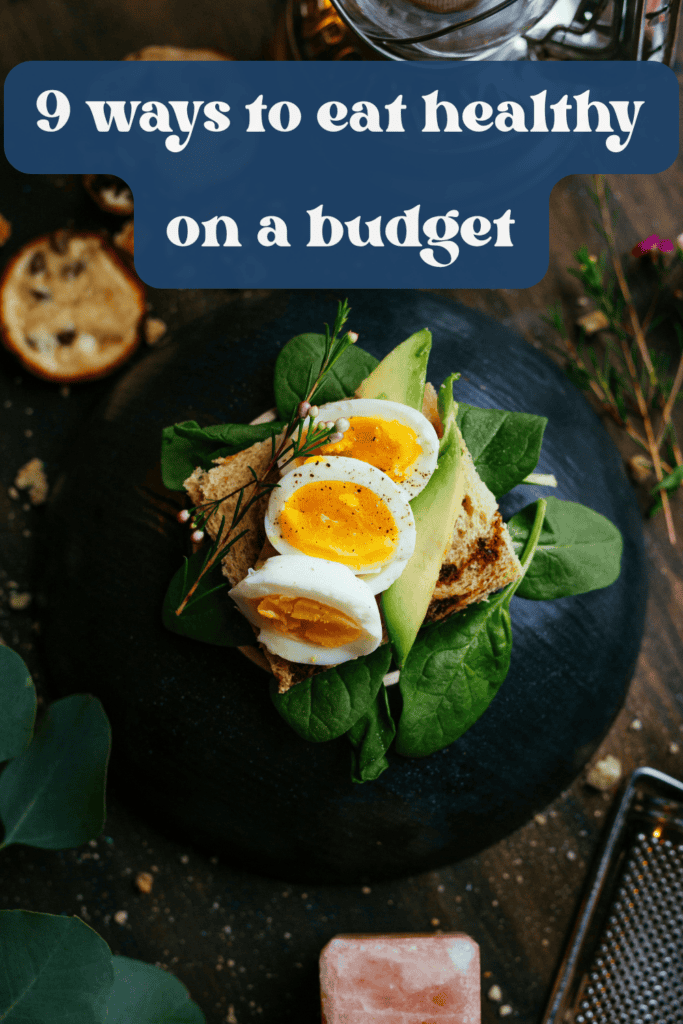
If you google “ways to eat healthy on a budget”, you’ll find endless tips and tricks. The hard part is finding the tools that stick. The ones you can carry into your every day habits without really thinking about them and realizing the habits you’ve been accustomed to that you may not need to follow. I’m going to explain why I choose the products I do and don’t, hopefully giving you more confidence to shop on a budget without giving up the things you love.
9 ways to eat healthy on a budget
1. Eat 75% whole foods, 25% convenience.
My first and biggest tip to save you money, is to try a 75/25 method of buying groceries. Most of your groceries are made up of “whole foods”. We’re talking vegetables (frozen or fresh), fruits, meats, dairy, and grains. A lot of these foods are going to make up your side dishes. Frozen is a good option if you’re tight on time. Try to get these without a ton of added sauces, but frozen can be both whole, fresh and convenient.
The other 25% is going to be convenience items. That includes pre-prepared meats that are already cooked (think chicken sausage or dinner kits), frozen pizzas, microwavable vegetables in sauce, on-the-go snack bars, etc. These are the typical convenience items we eat when we need something quick.
We are eliminating the all or nothing mindset because so many of us are too busy to stick to an “all whole food” diet. Whole foods are generally cheaper, but much more perishable. So we don’t want to waste money on foods that are going to go to waste, but we also don’t want to be spending all our money on convenience foods. A healthy balance is good for our mental health and wallet.
So if we were to make a meal that was 75% whole and 25% convenience, it would look like:
- Pre-cooked chicken sausage with a side of fresh spinach and brown rice.
- Fresh salmon with fresh broccoli and a bag of frozen, seasoned potatoes.
- Baked chicken with a pre-prepared salad kit.
2. Shop at multiple stores.
I know this is not realistic for some people, but if you can shop deals at multiple stores, then you’ll save money. A good example of this is buying in bulk the things you know you will use and go through, but getting fresh items at a store that you can buy a small quantity of.
Pantry staples can be bought in bulk for much cheaper. These are your every day items that are shelf stable. Baking goods, spices, grains, sauces. All of those things add up if you have to keep buying them over time.
I will go to costco or BJ’s for the bulk items I use every day, but will go to trader joe’s for my frozen dishes or produce and meat.
3. Get groceries multiple times per week.
When you’re eating fresh foods, you will inevitably run out of food quicker. Since fresh food don’t hold as long, you’ll likely need to stop at the grocery store multiple times per week. I actually prefer this because I don’t need to commit to a week’s worth of meals that I don’t know if I’ll even feel like eating AND it saves me time each time I go. I run in, grab the few things I need, and leave. ALWAYS make a list ahead of time before going in and do NOT go when you are hungry.
4. Repeat meals.
Once you get your budgeting down and you know roughly how much you spend, repeat “staple” meals weekly. It’s not only easier to go grocery shopping, it’s predictable, and you’ll know roughly how much you’ll spend.
If you want to get creative, swap out a different side or main protein, but keep the majority consistent.
5. Don’t always buy organic or feel you need to.
Unfortunately, our society has steered us into the belief that if it’s not organic then it’s “harmful”. This is just not true and is costing us so much financially, as well as, in relation to our health. If you can afford organic, great. But if not, choosing to forgo certain fruits and vegetables that aren’t organic is only causing you to miss out on key healthy nutrients and fiber. There are so many micronutrients found in fruits and vegetables that far outweigh the risk of non-organic produce.
It leads us back to the “all or nothing mindset” I mentioned earlier. You can eat a fruit that’s not organic and still reap a ton of benefits. Just wash your produce.
Also, here are are fruits/vegetables you absolutely do not need to be buying organic:
- Avocados
- Bananas
- Oranges
- Kiwi
- Lemon
- Lime
- Anything you peel and throw the skin away
6. Don’t fall for gimmicky labels.
It’s easy to look at a label and think something is “healthy” based off of the buzzwords that are thrown all over the packaging. Think of words like All Natural, Gluten-Free, Grain-Free, Hormone Free, Superfood, Keto, Probiotics, Pre-biotics, Clean, Low-carb.
I could put all those labels on a bottle of water if I wanted to. It doesn’t make the water any healthier. My point is, these labels can be deceiving and can make you feel like something is healthy based off the outside packaging. Instead, read the ingredients. A quick glance at the ingredients can tell you a lot more than the front label. A lot of times you’ll realize that one item promoting how “healthy” it is, is actually the same as it’s competitor with less spammy marketing tactics.
7. Try to make what you’re craving at home.
This goes back to our convenience foods! Some days we don’t want to cook. Some days we want pizza or chicken nuggets or thai. On days like this, I try to weigh out what is more cost effective. If I want pizza, it’s cheaper for me to go buy a frozen pizza than go out so that’s what I do. On days I want thai, it would be less cost effective for me to get a bunch of ingredients I don’t have, so I’ll go out and get thai.
Ignoring your cravings can lead to overeating and over indulging. That goes for takeout food too. In a perfect world, we would make all our meals at home, but it’s just not realistic. So when you can, try to replicate what you’re craving at home rather than going out if it’s more cost effective. If not, get what you’re craving and get back to budgeting.
8. Be flexible.
Saving money is all about being flexible. You may walk through the grocery store and see that a particular item is on sale that you could use to make a dinner that week. Or you may find that the fish you wanted to make is way overpriced this week. Being flexible with your meals is going to save you a ton. This comes with the practice of cooking at home, but it does become easier when you get good at it.
A good way to practice is to look in your cabinets now and try to make a meal with the ingredients you already have. It can be hard to be creative, but it will pay off in the long run.
9. Stock up on sale items.
Once you find a rhythm and get into the habit of budget shopping, you’ll start to repeat meals. This can be especially handy when you find sale items and this goes for any non-perishable and frozen items. Stock up! Sometimes you may have to revolve a meal around whatever item it is you’re hoarding, but it’ll save you time and money. Some good examples of items to stock up on are beans, grains, frozen fruits and vegetables, cooking oils, canned or jarred sauces, nuts/seeds, dried fruits.
Budgeting takes time. It takes practice. It takes creativity/flexibility. Don’t beat yourself up if you’re finding it difficult to come up with meals or you accidentally buy an item you already have. It happens to the best of us. I can’t tell you how many cans of beans I keep buying and forget they’re in my pantry. Once I do realize I have 4 cans sitting there, I’ll make a chili. And just like that, half my ingredients are accounted for.
I know saving money and budgeting food can seem overwhelming when you’re already on a tight schedule, but start small. Take one of these tips and implement them this week. Over time introduce more and eventually budget hacks will become part of the norm. It definitely does take some pre-planning and a well-thought-out meal plan for the week to execute, but if you take 10-15 minutes to sit down and plan, you’ll be saving money in no time.